It might be some sort of system that works within the normal UI…
Like how with Insult Sword Fighting in MI1, they probably had to figure out a system for it (how to have the responses come up randomly, how often a new response was shown, how to get those ones to show as new options for the player, etc.), even though they had the general dialogue UI already done.
1 Like
Ah, that’s true. It could be implemented using standard dialogue trees. Like: So-and-so was killed by… John/Jack/Mary/Frank… using… an axe/a club/a chainsaw… because… he wanted to inherit/he was jealous of…/he wanted revenge on…/he was protecting…/ and then each option could trigger a different sub-tree. That would be interesting.
1 Like
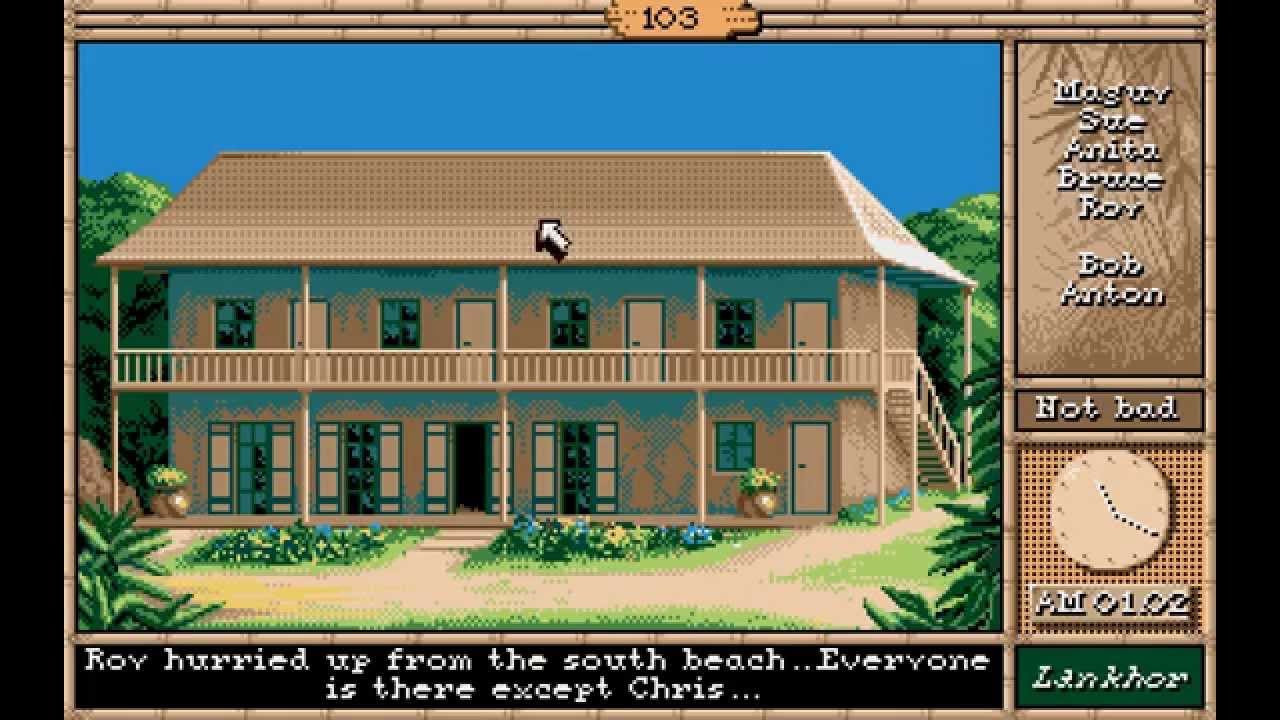
If you are interested in a “murder mystery” system you should have a look at the adventure game Maupiti Island. It’s not a very good game and the interface is cumbersome, but it focus on solving a “who dunnit”.
1 Like
What a great tip! The name sounds familiar—I’ve definitely launched it a few times, but I can’t remember why I never actually played it. Now is the time!
1 Like
Maybe because of the interface.  Be aware: You have to restart the game several times. That’s part of the concept: You have to investigate when each character is where at which time on the island.
ouch! oh well, we’ll see!
ok, the UI is completely nuts! what were they thinking? 
Yes!  But keep in mind: The game is from 1990.
The Interface is weird, but maybe you can get the game concept(s). Here is a “longplay” (just in case):
3 Likes
Nice graphics, shame about the interface
1 Like
Indeed. But you can do a lot of things. For example you can show other people objects and ask them what they think about the other characters. The magnifying glass is also a great idea - with a horrible implementation.
1 Like
I don’t know what it is, but I have a hunch that it’s connected with the fact that the detectives have to take a lot of photos. I have a feeling that there might be some sort of repeating mechanic, like in Delores’ game.
1 Like
Hmm… we already know that in the game you can take photos of everything. That has to tie into the mechanics, you’re right. Maybe in the end you end up with tons of photos laid out on a table—photos of people’s faces, photos of objects. And you have to place them in the right spot on a board to prove you’ve figured out who the killer is, what the murder weapon was, the motive, and so on. Certain objects could represent motives, so if you place the photo of the correct object in a certain spot on the board, you prove you’ve understood the motive. Basically, the photos are just a way to keep objects from appearing directly in the reasoning space. You actually have to photograph them to prove you realize they’re relevant.
2 Likes
Mmm, I hope the game is not TOO detective-y.
Or if it is, it’s only for a short section.
3 Likes
Dave Grossman joins the team as a writer -
Great news…
With TWP1 I felt like the humour was stretched a little bit thin over the course of the game, especially as it’s a pretty long game.
The funny parts were very funny, but I think it would have benefitted from a Dave or a Tim to pack some more in, and to also add a different flavour of humour in the mix too.
So it’s cool to have Dave working on TWP2.
5 Likes
I agree! These are great news!
1 Like
Latest Thimbleweed Park podcast
6 Likes
And here’s an AI transcription (unchecked):
Ron Gilbert: Welcome to the Thimbleweed Park 2 stand-up meeting podcast. Here with me today is David Fox.
David Fox: Hey there.
Ron Gilbert: And Gary Winnick.
Gary Winnick: The fun never stops.
Ron Gilbert: Never. So, what have you guys uh been working on last week?
Gary Winnick: Um okay, well I’ll go first I guess. Um generally speaking at this point in the project, we’re just mainly working on design, so we have um several design meetings a week. And um our process really is just going through and doing a lot of brainstorming, and that’s mainly what I’m doing right now. We sort of write a lot of stuff, we have discussions, and then Ron crams them into puzzle dependency charts and hopefully they make some kind of sense.
Ron Gilbert: Usually. Usually they make sense.
Gary Winnick: Yeah. And I know that since since I’ve watched a couple of um podcasts Ron has been in, I can mention that we’re mainly working on I’m going to say complicated murders right now. I’m not going to say much more about it. Um oh, and I can say I guess that a lot of this takes place in the mansion. God knows who would do a game where stuff takes place in a mansion.
Ron Gilbert: Crazy people.
Gary Winnick: Yep. And it’s really, at least for me, been a lot of fun to work with these guys, because I, you know, based on our history, we we are very much I think work in a similar fashion, and we can kind of in some ways finish each other’s sentences, which is actually real handy when you’re trying to design something.
Ron Gilbert: Yeah, we’ve worked together so much.
Gary Winnick: Yeah. Um yeah, and so mainly what I’m doing is just you know, we brainstorm stuff, we write notes, we review the notes, and we just kind of bat them back and forth. And that’s kind of the way the design process works. And as I said, Ron tends to try to keep us on track by actually trying to fit things into some sort of coherent chart.
Ron Gilbert: Yeah, I try to keep like a page that is, you know, accurate. You know, there’s all the brainstorming, and then I do I do one one page—we keep everything in Notion, and so there’s one page that is that is what we have decided, and then I do the dependency chart for everything that we have talked about. And that often brings up issues, right? As I’m doing the chart, I’m realizing, “Oh, well we didn’t solve this problem.” So we need to kind of fix that problem um in some other some other meeting.
David Fox: Yeah. It’s like when I’m starting to implement some of this stuff, what sounded clear before, all of a sudden there are all these ramifications that we really didn’t go over. So either I I do a pass based on what I think, or or Ron and I might have a call to like go over, “Well, what happens if this? What do you do with this? And how how do we actually want to do it?” Um you know, the details.
Ron Gilbert: Yeah, I mean stuff can look really good on paper, but then when you start actually doing it, you realize, “Oh, we didn’t think of this and this and this.” So it’s kind of why I like to not just design on paper, but you design on paper and then you implement the kind of prototype version, because that flushes out a lot of problems with your paper design.
Gary Winnick: N- Now, currently you know, we have a we have a Steam build that we’re using to sort of uh playtest with and um iter- iterate in, and um I’m curious I’m assuming you know, what is the is the engine that you’re using for that? I mean, it looks pretty much the same as Thimbleweed Park. Have you changed that or upgraded that based upon your experience with Monkey Island or other stuff?
Ron Gilbert: Yeah, the engine has gone through several evolutions, right? It started with Thimbleweed Park, and then it uh you know, it got used for some of my action games like Death by Scrolling, and then it got used for the Delores game, and then the Monkey Island, and then uh you know, another game, and then this game. So it’s I mean, it’s kind of the same engine, but it every every iteration it just goes through a lot of changes.
Gary Winnick: I mean, because it seems to iterate certainly Well, you know, my experience is I’m used to Scumm, and you guys used to be able to iterate that pretty immediately, and you iterate this pretty immediately, so I don’t know how similar to Scumm it is. I just like to say that because that’s the engine that I was the most familiar with.
Ron Gilbert: Yeah, it’s I mean, it’s not similar you know, in the language it uses, but it’s similar in philosophy. So that’s why you get that really fast iteration uh with this engine.
David Fox: For me, I guess growing up on using Scumm for adventure games, it was a really easy move over to this, um transition because of that, because the the thought process, my thought process in order to implement something was pretty much the same. I mean, there was a couple of graphic adventure engines that I used, I guess they were based on Unity plug-ins, graphic adventure engines that had a totally different way of implementing it, like, you know, more graphical interface where you’re connecting nodes and and I hated it, cuz it was just so It was like I felt like in a straitjacket. Um and coming back to this was was really nice.
I should say what I’ve been working on. So after our meetings, Octavi gets a a list of some rooms to put in, and I also have the the flow chart, or the uh the puzzle dependency chart to use to figure out which puzzles I can implement with the rooms I already have, and sometimes I’ll do programmer art of an object just to as a placeholder so you can pick it up and not worry about what it looks like, but just so you can pick it up and use it. And then you know, try the different things. So that’s how we figure out, okay, well this UI didn’t quite work, how can we make this work so it’s less cumbersome for the player, and do iterations there. It’s all all with, you know, temp art, black and white or grayscale.
And I still have a a bunch to do from the first section, so but it’s getting I think I’m closing up a bunch of the loose ends. It’s kind of fun to see it come together, and you actually can go through several of the puzzle flows. And more of the same for coming up. I have new rooms that came in from Octavi, and you know, some are the some we’re reusing old rooms, either temporarily or permanently, but I think What do you think the balance is going to be, like half new rooms?
Ron Gilbert: Yeah, I’m planning on like 25% you know, are rooms from the original game, and then 75% are either new rooms or they’re just different kind of views and takes on the existing rooms in the game. And I mean Gary mentioned the game taking place in the mansion, and it’s partially true. Um you know, a lot of it does take place in the mansion and we’ve expanded the mansion and added new rooms that you hadn’t seen the first one, but you do spend a large chunk of your game you know, walking around the county and the town and other areas, so it’s not confined in the mansion.
Gary Winnick: Yeah, I’m going to say this and then Ron can cut it out if he doesn’t like it, but in in this particular game, it would appear to me at this point, we’re planning on having basically four distinct chapters. Am I allowed to say that?
Ron Gilbert: Yeah, four, yeah, four four acts, chapters, yeah.
Gary Winnick: Yeah, okay. So there’s there’s a, you know, piece of information for people to hear, unless Ron has already, you know, given that away on one of the podcasts he’s been giving stuff away on.
Ron Gilbert: Yeah, I think I already talked about that it that it happens in four sections. Maybe not. Maybe this is breaking news, I don’t know.
Gary Winnick: Mm. And, you know, it’s as all of our stuff is, it’s very character-driven.
Ron Gilbert: Is that all, David?
David Fox: That’s all I think I’ve been working on, just also shaking out like so there’s I have old code that I can use as as an example and use that and adapt it for here, both from um Monkey Island and from Thimbleweed Park 1. And often there’s a command that we used before that wasn’t available now or wasn’t isn’t implemented yet, so either find an alternate way to do it or ask Ron to bring that one over into the codebase. And so no stops, really. That’s really good. And the frustrating part, which I was really worried about, was because of the time zone differences, that I’d be working and have to wait four, five, or six hours for a bug to get fixed or or something to be added, or an explanation about like why I don’t I’m not why what I’m doing isn’t working. Um until Ron until we move into overlap times—
Ron Gilbert: Right. Until I wake up.
David Fox: Yeah. So like Ron’s 9:00 a.m. is our 2:00 p.m. on the on Pacific time, and Gary’s 5:00 p.m., but Gary’s not doing coding, so it’s not as critical to have Ron’s feedback, I think.
Gary Winnick: Yeah, I’m going to start doing that next week.
Ron Gilbert: Yeah, I’m turning the engine over to Gary.
Gary Winnick: Yeah. And that’s why this game will never be finished. I’m going to do coding and Ron’s going to do art.
Ron Gilbert: Uh-oh, no.
David Fox: We used to have Scumm University back in Lucas. Would this be Dinky U?
Ron Gilbert: We should get T-shirts printed with Dinky U on them. Uh let’s see what I have been doing this week. Well, last week I was uh at uh NZGDC, which is the New Zealand Game Developers Conference. That was up in Auckland, so I had to travel, you know, it was like an hour by an hour flight, so it’s not too bad. Um but that was fun. It was fun seeing people. It really reminded me of what GDC was like like in the early '90s. You know, it’s just a lot less people, talks were a little more focused, and it was a lot of fun. It was great fun to go to.
David Fox: A lot less people in suits.
Ron Gilbert: Yeah, I don’t think I saw anyone in a suit.
Gary Winnick: Was Ron forced to speak?
Ron Gilbert: No, I I didn’t speak. Jenn spoke. Jenn had a talk, she had two talks actually.
Gary Winnick: I’d rather listen to her than you anyway, Ron.
Ron Gilbert: Yeah, me too. So I did that, and I’m also So let’s see, what else am I doing? Fixing bugs for David. That’s big big piece of work. Derek and I just started working on a brand-new particle system, um which is a little bit based on the one we did for Return to Monkey Island. This game probably won’t be very heavily particle-focused, but it’s nice to kind of do a new system, so just started working on that. Had a big call with Derek uh yesterday, kind of going over what it should do.
Mark is going to start in a few months, and so I’m just trying to get ready for him to start his work. That’ll be exciting, because you know, a lot of the black and white art will suddenly get replaced with, you know, beautiful color art. Also looking at a new bug system. The bug system we have right now it works, but I’m not sure it can scale to the end of the project, so
David Fox: This is bug tracking rather than bug creation.
Ron Gilbert: Yes, that’s Yeah, bug creation’s your job, David.
David Fox: Yeah, that’s what I’m doing. Chief bug creator.
Ron Gilbert: Yeah, this is um tracking the bugs. You know, in Monkey Island we had uh we finished with just under 7,000 bugs, so we need to make sure that our bug system can, you know, scale to to that level by the end of it.
David Fox: And you had some news about someone new starting this week.
Ron Gilbert: Oh yeah, Dave Grossman’s starting. That’ll be fun. So just getting him up to speed, getting the new um development engine installed for him so he can actually you know, play the game and, you know, alter dialogues and do that. So, yeah, he’s starting. That’s good.
David Fox: Yeah. I I know that back I while he was trying to play through the game without a lot of advanced knowledge, you know, it felt like I was I was getting mo- multiple phone or not phone calls, but you know, messages on Discord for the first day or two. Well, he’s like, “Well, how do you do this?” It’s like, “Well, actually, that’s nothing to do with this game. That’s left over from the previous time we used this room, so don’t bother with that,” or So, you know, trying to make sure he didn’t spend a lot of time trying to solve something that wasn’t either wasn’t implemented yet, or or wasn’t intended to be implemented. And I think he got through most of what we had in a day. But now he can check again, cuz it’s changed.
Ron Gilbert: Yeah, we should just release the buggy unfinished version, and people will have a lot more gameplay hours. So, that’s um that’s all I’m doing. Next week it’s pretty much more of the same, um except for, you know, NZGDC, obviously not going to that again. But uh just getting uh getting the particle system, fixing stuff um for Derek. I don’t think there’s a lot of new features that need to get added to the engine, so I think that is is kind of uh that is kind of done. So and then design, you know, doing a lot of design and puzzle dependency charts and writing and stuff like that.
Gary Winnick: Yeah, I can just play what I’m doing on a loop. You should just uh, you know, we should take one of these that I’ve already recorded, then you could just fit it into the the upcoming podcast, and then you have people guess whether or not it’s one that I did already, because they’re all going to sound the same, at least in the short term.
David Fox: Oh, something else I need to do this weekend is write to work on my first pass for my talk at AdventureX, which I’m going to in early November. And my what I’m planning to talk about was kind of first, I I’ve talked before about, you know, what it was like back in the '90s, '80s at Lucas Lucasfilm, LucasArts. And I’ve done that before, and I don’t think it’s really of interest as much. So my topic is more on kind of the evolution of at least the adventure games I’ve worked on in relation to being empathetic towards the player, and all the things we’ve done over the years to make it less onerous for the player to get through the game, to actually enjoy the game without unreasonable roadblocks. And where I I feel like we did a lot of that in Monkey Island, Return to Monkey Island, and kind of the the things we’ve done, but also the philosophy behind that compared to maybe other companies that made adventure games. And so that’s kind of where my background task is, and see if I can start putting it down into into slides this weekend.
Ron Gilbert: Yeah, there’s big quality-of-life changes, you know, that you just want things to be not necessarily easier, but just smoother, you know, that that kind of that happens, like the the you know, we added the hint system, and um there was that recap feature in Monkey Island.
David Fox: Yeah, I thought that was That was brilliant.
Ron Gilbert: Yeah.
David Fox: We’re used to that on TV shows, that hey, if we if we watch a show every you know, once a week or something, what what happened, I don’t remember what happened.
Ron Gilbert: It’s a little annoying if you’re like binge-watching, you know, because it you get the recap, and it’s like, “Yes, I watched this 30 minutes ago. I don’t need a recap.”
David Fox: I I kind of watch the recaps anyway, because often they’ll throw something in from 10 episodes earlier to remind you of some character that that was like a temporary character, but’s coming back in this episode. It’s like, who’s that person? Oh yeah, okay. So so I watch them because it’s sometimes they’ll they’ll do it as a jog to your memory from someone who you haven’t seen for a long time.
Ron Gilbert: What do you think the biggest quality-of-life change that we’ve made since, you know, Maniac Mansion?
David Fox: Well, other than the I mean, there’s the technical part of it, you know, obviously the the floppy disk swapping and load times, which obviously no one would tolerate now, but that’s a function of technology, not something that we actually did. I I think embedded hints hint systems so that you don’t have to go outside the game I mean, back in the day when we were when we first did this in the '80s, there was no internet to look up hints on, so you were really stuck waiting for a magazine to come out with a walkthrough or or your friends, if you could get them to to tell them if they played the game, to tell you what they did. Or you had to go onto the LucasArts hint line and pay your dollar an hour, what dollar a minute fee that you had to get charged, or buy a hint book. And now it’s all inside the game, you don’t have to leave the game. And just knowing that you have access to that without penalty, really. You’re not getting points deducted if you get a hint. You might emotionally not feel like you want to do it.
And, you know, going with progressive hints like we did before, um that’s that that really hasn’t changed. I think, you know, that what what happened previously, I think a major one for the last few games were the to-do lists. Um you don’t Yeah, you don’t need a separate notepad with where you’re taking obscure notes, you can’t really figure out what what you wrote down anyway, that it’s tracking what you’ve completed and what more or less what you have to do to reminds you to stay on focus. And that’s especially important when the game has multiple tasks that you’re trying to complete at the same time.
And I’d say we also threw a bunch of stuff in where if we notice that the person seems to have taken a long time to solve something, it might have dialogs that get turned on, or little comments or hints or things that might push the player in the right direction, because I feel like our ultimate goal is for the player to complete the game, not to stop them from completing the game. We want them to have the full experience. So everything we do is really designed to I think have the aha! experiences and also to get through to the end.
Ron Gilbert: Yeah, I mean there’s always kind of a a struggle, right? Because you want to make it easy for the players, or smooth for the players, but you don’t want to make it easy, right? You don’t want the hint book to kind of solve puzzles, you know, because you see it in the hint book. So that’s always something we’re having to balance, you know, just making things smooth, but not necessarily easy um with these quality-of-life features.
David Fox: All right, and I I think having at least two levels of difficulty was a major one. So if you want to do it more casually and not get a not, you know, if your frustration tolerance is a lot lower, you just go with easy mode, and then come back later with a hard harder mode if you want to try it again.
Ron Gilbert: Right. I was talking to somebody a while ago, and they were playing uh this was Monkey Island or uh Return to Monkey Island, and and they were just playing the game through the hint system. They would just use the hint system continually as they played the game, so they weren’t really solving the puzzles, you know, beyond the hint system. And I thought, well, that’s that’s kind of dumb, you know, that you’re doing that, but they were having a great time. You know, so, you know, at some level, they were still having a lot of fun, and I think in the end of the day, it really is about the player having fun. You know, even if they’re not playing the game the way you think they should, if they’re having fun playing the game, that in some way is all that really matters.
Gary Winnick: That sounds like when you were talking about how you were try, you know, had watched kids play your early games, Ron, and they didn’t understand what they were doing, but they would just still play them and have a great time.
Ron Gilbert: Yeah. Yeah, that was the thing with the kids games, you know, because they you know, the really young kids, they didn’t they didn’t really understand, you know, the puzzles and stuff, but they were still having fun, you know, walking around the world and doing stuff. Well, I think that’s it, unless uh you guys have something else?
David Fox: I don’t think so.
Gary Winnick: Not at this time.
Ron Gilbert: Well, thanks for joining us for another Thimbleweed Park stand-up meeting podcast. These will probably get a lot more interesting, I hope, you know, as the project goes on. We’re so early in design, that’s just a lot of the same thing.
Gary Winnick: Yeah, I mean, you you could cut the excitement right now with a fork.
David Fox: Or with a slotted spoon.
Ron Gilbert: Yeah, a spoon. With a spork.
Gary Winnick: With a with a spork.
Ron Gilbert: Okay. Well, I will uh talk to you guys later.
5 Likes
If there’s one thing we know about Ron it’s that he doesn’t like making the same game twice. Maniac Mansion and Money Island 1 are two very different games, Monkey Island 2 is almost as different to MI1 as Curse of Monkey Island is to MI2, and Return to Monkey Island is nothing like TWP1 and very different to MI1 and MI2 standing out on its own in the series.
I would not expect TWP2 to be the same type of game as TWP1, and heck I really hope that the verb box is gone this time (I wasn’t even that happy with the RtMI verbs either because the way that your options pop up every time you hover on puts the UI in your face even more than the verb box).
Whatever Ron’s plans are they’re already set. They’re in full pre-production which means the script (the story) is basically compete. What they’re working on now is getting ready for production so that other people can start work on the art and animation and writing etc.
2 Likes
That plural reinforces my hunch that there will be a multiple-murders mechanic in the game. If true, I wonder how they will fit it into the story.
And about the story, I also hope that Ron will explain what happened to Ray after the first game. But it’s Ron, so explaining is unlikely.
2 Likes
So, if I remember correctly, Ron said that all the murders take place in the “Mansion Mansion.” That’s really interesting, and I can’t wait to play a game with a bunch of murders happening in a mansion, Agatha Christie style!
And actually, I can’t think of a game that’s ever done this really well. The ones that come to mind all had the same problem: if you weren’t in the right place at the right time, you had to start over, or you’d miss parts of the game, or end up unable to solve the mystery, that sort of thing.
(Although, to be fair, I’ve only actually played one of them: Laura Bow 1. Ok, and The Last Express. And Cruise for a Corpse, which takes place on a boat rather than in a mansion, but is pretty much the same idea. I honestly can’t remember if it had that particular problem, though it certainly had plenty of others! And Maupiti Island, if you count the 10 minutes I spent playing it. :))
2 Likes