I can’t remember. If only the game had recorded my attempts 
Once I discovered that your IQ level doesn’t go back up again after you solve a few puzzles, I embraced it as a funny extra rather than a measure of how good (or rather, bad) I was 
I can’t remember. If only the game had recorded my attempts
Once I discovered that your IQ level doesn’t go back up again after you solve a few puzzles, I embraced it as a funny extra rather than a measure of how good (or rather, bad) I was
It has! But I need to go through them
But the majority won’t make sense to me and I’ll never know which ones made sense to you.
Oh! Then if you send me them, I can probably trace them back to what I was thinking at the time. (I have to admit, the very first attempt was complete nonsense on purpose  )
)
I don’t think I explained myself well on this one. I think there is a ton of humor upon missteps. But there is lag, at least for me, that very much dissuades a ‘reach’ answer. Like when you are somewhat sure you are right (but you’re wrong) you have to deal with many clicks and loads.
The things that make sense will either be handled, or they will be impossible to compose. It’s that you have played an unfinished product. 
Now I know the things you have tried, so I can either make them impossible by hiding the corresponding ending phrase, or handle them.
Too bad I changed the interface so you’ll all have to do it again
It looks good!
I’m comparing this new interface with the old one, which I’m currently playing with: I think it will be a good compromise.
same here…
Don’t underestimate learning through making mistakes. Experimentation (and failure) is what leads to great new ideas and solutions in real life, so why not in an adventure game?
If we would only allow inventions and solutions to problems in real life for which the outcome was completely predicted upfront and understood… we would only have boring things. Heck, even today most technical advancements are based on a “just-good-enough” understanding to put them to good use.
In short: it is not knowing what the consequences will be that makes life (and games) fun and interesting.
Games are even just that: a (relative) safe sandbox that encourages experimentation and trying things you might be afraid to donin real life.
Although I do get and value your game mechanic to not allow brute forcing, it feels a bit unnatural exactly for the reasons I mentioned. Just my opinion of course!
Oooh!! Writing this down just made me come up with a game mechanism for “Sushi’s Adventure”
Time to start selling those $20 official hintbooks!
it’s because of the “a-ha moment”. (which of course is https://youtu.be/djV11Xbc914)
That’s what I like in adventure games. If you can solve a problem by decomposing it into smaller problems, you never have the a-ha moment. So I want to prevent it. That’s all. Too many times I solved a puzzle by decomposition and understood only after the fact what I was supposed to do… for example:
I use the priest’s white collar and I see the character wearing it automatically. That suprises me, so I understand “oh, I had to disguise as a priest. that’s what I had to do”. But I would never have understood it on my own…
I use the crate(or the fridge) and I see the character entering the crate (fridge). This surprises me. and then I understand what this was for. (get in the fortess, hide from the radiations…) I didn’t solve the puzzle. I observed what I was supposed to understand , but didn’t understand. This deprived me of the a-ha moment… the gameplay becomes a dull “click here and there”, until something happens.
I attach two objects to each other by completely random trials, I am suprised to see that they combine, and then I understand what I was supposed to build. This is incredibly lame… (happens in Indy 4 too)
In general, what you write seems completely reasonable but it’s very abstract. Once you make examples, I doubt this works. I’d like to see examples , because abstract discourse always seem reasonable.
As an aside, in the real world you are practically guaranteed not to reach your goal by trying random things. That’s because of the huge amount of things in the real world. (though you might find a solution to another problem by random trials, but this is besides the point, and is possible in my UI as well – see the mermaid function; you didn’t call the mermaid with that purpose, but it ended up serving another). So, to get back to the point, in an adventure game , where by necessity there must be fewer objects than in the real world, this is no more guaranteed: it’s now possible to solve a problem by random trials. So you need something from the UI, to restore the parallel with the real world. In my solution, it’s the fact that I ask you to explain “why” this object works. This is artificial, but is made necessary by the low number of objects , unlike the real world. Until a better solution is found… (which doesn’t involve creating a sandbox with millions of objects)…
@seguso: I’m still interested in playing your game, so should I wait until you’ve finished the new UI?
Yes man, please wait for the new UI at this point 
OTOH if you really want to play, who am I to stop you
The game is almost playable with the new UI. it will be ready in a couple of days. but then there will be a lot of unhandled object-character combinations. Handling them will take more time. (you will choose if you want to play with the unhandled combinations or wait longer)
Even in TWP, there are quite some examples of what I’d call “solving a puzzle chain backwards”.
You know you need C to get to D. And B to get to C. You just don’t know what A is, to get to B. And then you start to decompose to get to A.
When you finally find A, you’ll have the satisfaction of solving that one. But not B to D, since the aha-moment for those is gone. It will feel like a very linear puzzle.
Even to this day, there are some alternative solutions to puzzles or situations in Zak McKracken to be discovered. Different objects you can use or methods you can apply to wake up the bus driver, digging a hole, opening up floorboards, escaping jail and mindbender cell, stealing back your artefacts, not running out of money, paying your phone bill, ways of getting out of space, getting back home from the Bermuda triangle, lighting fires, killing (or not) multi-headed animals…
The acceptance of these alternate ways and parallelism in the game is really wonderful! And it never takes away from the aha-moment when some of the things you tried earlier might spark a new idea to a puzzle you just discovered.
The downside is that because of unforeseen combinations a player might end in an unwinnable state, especially if items are “consumed”.
Luckily the toilet paper supply gets replenished before every airplane flight and the stewardess returns your misplaced egg. Not sure if Zak has one of those auto-refilling fridges that were the newest hype in 1996.
Even in Maniac Mansion there are some puzzles that allow relative messing up on the player’s side (e.g. if you rip the envelope, you can still beat the game for most combinations of kids).
The best puzzles involve a parallel chain which you can solve in any order. Like the spitting contest in MI2.
Of course according to your logic, why would you like to participate in one? Let alone try and win one? Because there is a prize, of course!
I am ok with not knowing what use that prize may or may not have later.
But I realise that’s because I grew up with the idea that entering a new room or being able to pick up a new object was both a rewarding experience and an indicator for making progress in a game.
very interesting. I’ll read carefully later! thx!
I also noticed relationships between the two. Like if you use the fork for one it bends and you can’t use it for the other. These were details I definitely appreciated.
But you could send the knife and gain money!
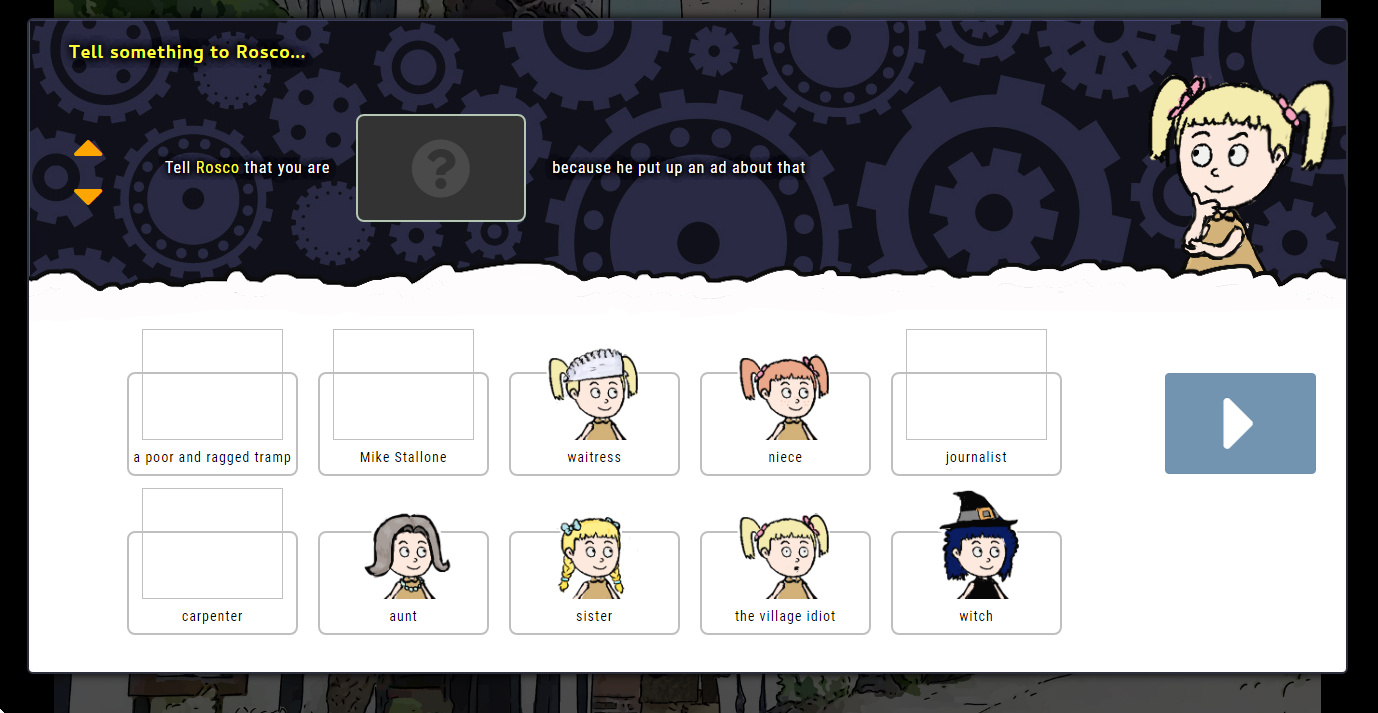
I couldn’t simplify the “talk” puzzles more than this… I couldn’t remove the “because” part, because it is needed to prevent you from saying the right thing by chance (or before you have the corresponding clue):
Someone might say “don’t show the correct choice before you have the corresponding clue”, as is usually done. But I don’t like this, because then you see a new choice and it catches the eye…
Not if all of them appear once you see them. Like the insults/answers in swordfighting, you start with just two or three explicitly bogus ones (e.g. "because you have no idea what you’re talking about / you’re just guessing / the pope is not a king) and add new answers whenever you learn new things.
Hmm no, maybe it doesn’t work. Then you’d only have the correct answer for the first puzzle. Nevermind.