Hahaha. Sure. It’s just that I went directly from the C=64 to Windows 95 – with nary a computer in between. I have very fond memories which are compartmentalized to that period.
dZ.
Hahaha. Sure. It’s just that I went directly from the C=64 to Windows 95 – with nary a computer in between. I have very fond memories which are compartmentalized to that period.
dZ.

I would have liked the MM style, too, but I appreciate the level of detail in Mark’s artworks. Also, I think that the music and the voice-overs would have sounded too sophisticated for the MM style.
I like both, actually. They have a different style and I find it difficult to compare them.
Thanks to rhubarb by @DanielWolf we even got lip-sync!
Also a MM/Zak-style game with dialog trees would have been strange… (remember the discussion if there should be a dialog system at all?)
Agreed! 
I agree. I remember playing adventures with a similar graphics style as a child, and they all had a certain kind of simplicity about them. Combining that with voice-overs and full background music might have resulted in a somewhat jarring experience.
I think this overall change in style is reflected well in how Ron changed the way he talked about the game. He went from “like … finding an undiscovered LucasArts adventure game” to “how you remembered [classic adventure] games, not how they actually were.” To me, that’s exactly the point: Unless you compare the two styles side-by-side, the final style still rings true to your memories of those games. At the same time, it is a much richer experience.
One strange thing that happens to me is that sometimes I prefer a Mark’s wireframe to the corresponding final art.
Can you give an example?
I’m on mobile, now, and it’s not easy to find and copy the first wireframes drawn by Mark, but for example I like more his first backgrounds for the circus.
maybe you like black outlines?
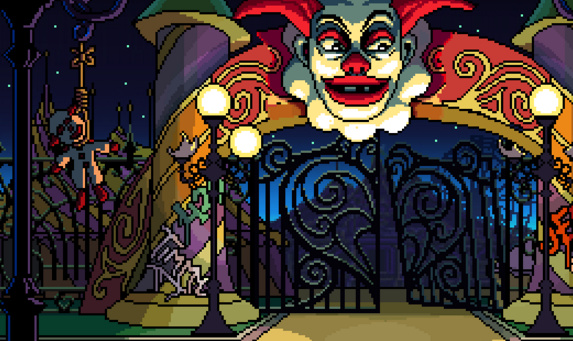
Or the restrained but clever use of color…
I think that the reason is that it has less shades of colors, which to me is a more pure form of pixel art. Fewer colors give me the impression that they were hand-picked and that everything was painted pixel-by-pixel.
Have a look at only the windows in this.

Only a few white pixels in the left upper corners turn something that is esentially black squares into something that feels tangible, thick, round and having light reflect in it.
I think that´s genius.
I agree wholeheartedly. Not to take away anything from Mr. Ferrari’s final art, it is indeed very beautiful; but there is something to be said about the art of crafting beautiful imagery that conveys depth, meaning, emotion, and atmosphere with the subtle and clever use of a very limited palette on big chunky pixels.

dZ.